How worried should Kilmarnock fans be by losing start?
The Kilmarnock crisis has arrived with alarming speed. Just months after Derek McCann guided the Ayrshire club to a dramatic survival finish — winning their final four league fixtures and scoring 13...

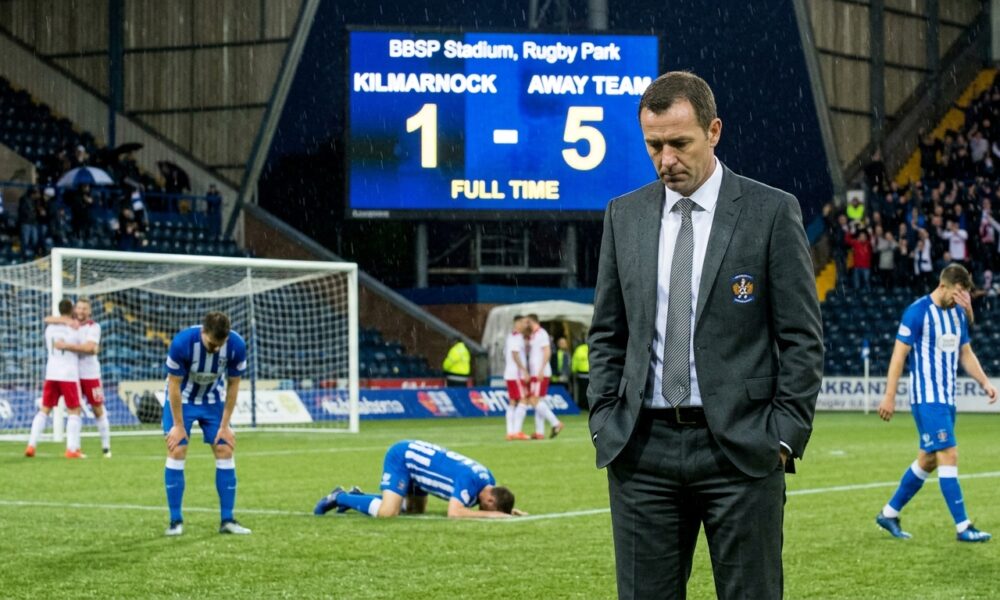
The Kilmarnock crisis has arrived with alarming speed. Just months after Derek McCann guided the Ayrshire club to a dramatic survival finish — winning their final four league fixtures and scoring 13 goals in the process — the team has hit the new campaign in reverse. Conceding four against St Johnstone, five against Celtic, and another four against Dundee United has left Rugby Park shrouded in anxiety rather than optimism.
McCann’s appointment in January was something of a gamble. Handed the reins with the club floundering near the relegation zone, he paired with assistant Billy Dodds and leaned heavily on the loan brilliance of Rangers winger Findlay Curtis to engineer a remarkable turnaround. That late-season momentum has evaporated entirely, replaced by a Kilmarnock crisis that raises serious questions about the manager’s tactical approach and the squad’s readiness for top-flight football.

Table Of Content
How the Kilmarnock Crisis Unfolded
The contrast between the end of last season and the start of this one could hardly be starker. Where Kilmarnock once attacked with freedom and confidence, they now look fragile at every turn. The 13 goals shipped in three outings tell only part of the story; the manner in which they have been conceded points to deeper structural issues that McCann must address urgently.
Against Dundee United, the hosts created opportunities of their own but failed to convert them. At the opposite end, goalkeeper Max Stryjek was beaten four times yet could still claim a respectable individual performance — a damning indictment of the protection, or lack thereof, in front of him. When your shot-stopper concedes four and still emerges with credit, the scale of the Kilmarnock crisis becomes impossible to ignore.
Tactical Flaws Exposed by Halliday
Former Rangers, Hearts and Motherwell midfielder Andy Halliday has offered a sharp diagnosis of the problems afflicting McCann’s side. Speaking on BBC Sportsound, Halliday pinpointed the diamond formation as the root cause of the defensive chaos.
“I felt there was a lot of promise for Kilmarnock coming into this season, given that from when McCann came in to the end of the season, they rose to fourth in the form table,” Halliday said. “I don’t think they look comfortable in their shape. I hated playing in [a diamond]. When you’re the wide man in that, you’re asked to do a power of work, in and out of possession.”
His analysis cuts to the heart of the Kilmarnock crisis. The system demands that wide players provide width in attack before tucking narrow to defend, a physically exhausting dual role that leaves gaps along the flanks. Halliday was particularly critical of the full-backs, who are instructed to push high when the team has the ball but are then left isolated in one-on-one situations without the ball.
“They don’t have Findlay Curtis or the like in front of them, with high energy, who can come back and double up,” Halliday added. “As much as they’re struggling defensively, I don’t think the shape is helping because they’re exposed.”
The absence of Curtis, whose loan from Rangers provided both creativity and defensive diligence on the wing, has stripped Kilmarnock of a critical safety net. Without his energy to track back and support the full-backs, the diamond has become a liability rather than an asset.
Injury and Debut Woes Compound the Problem
McCann’s selection decisions have also come under scrutiny. Two debutants were thrown into the defensive line against Dundee United — centre-half Cathal McCarthy and full-back Jonathan Meier — meaning half the back four were experiencing Premiership football for the first time.
The experiment backfired. McCarthy conceded a penalty, while Meier was withdrawn at half-time having failed to adjust to the pace and physicality of the top flight. To make matters worse, defensive stalwart Robbie Deas was forced off early through injury, robbing the backline of its most experienced organiser at the worst possible moment.
Everything that could go wrong, did. The Kilmarnock crisis is not merely a run of bad results; it is a convergence of tactical rigidity, squad inexperience, and unfortunate injury timing that has left the team looking vulnerable in virtually every department.
What Happens Next Against St Mirren?
Wednesday’s visit of St Mirren to Rugby Park already carries enormous weight. While labelling any fixture in early September as “must-win” might seem premature, the psychological importance of avoiding a fourth consecutive defeat cannot be overstated. At the very least, it falls into the “must not lose” category if McCann is to halt the momentum of this Kilmarnock crisis and restore some belief among a support base growing increasingly restless.
The manager faces a difficult balancing act. Abandoning the diamond would represent an admission that the system is fundamentally unsuited to the current squad, yet persisting with it risks further punishment from opponents who have already identified its weaknesses. Finding a compromise — perhaps by adjusting the roles of the wide players or offering greater protection to the full-backs — may be the only way to steady the ship.
Kilmarnock have proven they can recover from adversity under McCann’s leadership. The turnaround that preserved their top-flight status last season was genuinely impressive. But the Kilmarnock crisis unfolding now is testing that resilience to its limit. Three games, 13 goals conceded, and a squad looking short of answers. Wednesday cannot come soon enough — and it cannot go badly.